Australian Music Business Explained: What Every Independent Artist Needs to Know
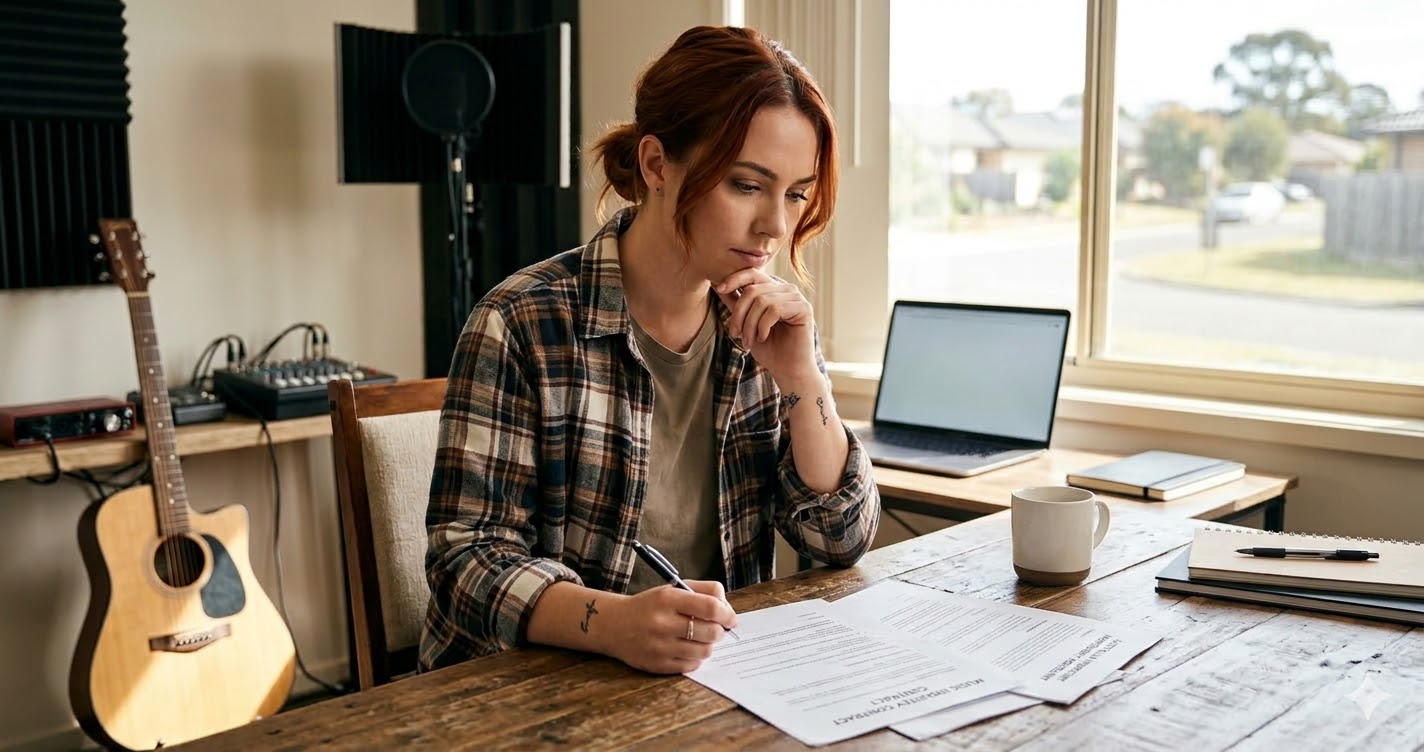
You don't need to be a lawyer to use Songpact — the platform explains these terms as you go.
- Copyright in Australia is generally automatic, but ownership disputes are still common
- Songs and recordings are different rights, and they are often owned differently
- APRA AMCOS relates to songwriting royalties; PPCA relates to certain recording-side royalties
- Verbal understandings are risky, especially when money, splits or releases are involved
- Clear agreements help artists avoid disputes before they start
Generated for clarity. Always refer to the full agreement terms.
You've written a great song. You've recorded it, played it live, maybe even landed a sync opportunity. And then someone hands you a contract, or worse, they don't. What happens next can define your entire career. Understanding music contracts in Australia starts here.
For independent artists like Indie Izzy, a singer-songwriter building her fanbase in Melbourne, or Session Sam, a session musician clocking up studio hours in Sydney, understanding the Australian music business isn't about becoming a lawyer. It's about not getting caught out.
This guide breaks down the key legal foundations that every independent artist in Australia should understand — from copyright to collecting societies, to the contracts you'll encounter along the way.
Why Music Contracts Matter for Independent Artists in Australia
A handshake deal might feel fine when you're recording demos with a mate in their bedroom. It stops feeling fine when that track streams ten million times and you're not sure who owns what.
Most music contracts exist to answer three basic questions before a dispute ever arises:
- Who owns the copyright?
- Who gets paid, and how much?
- What happens if things go wrong?
In Australia, music agreements are governed by a mix of contract law, copyright law, and industry custom. Without a written agreement, you're relying on courts to figure out what two people intended, which is expensive, slow, and rarely satisfying for either side. Navigating music contracts in Australia doesn't have to be overwhelming, but it does require knowing the basics.
For Indie Izzy, this matters when she collaborates with a co-writer on a song, or a producer on a track. For Session Sam, it matters every time he walks into a studio: is he being paid a flat fee, or does he retain any rights in his performances?
Getting these questions answered in writing, upfront, is the single most effective thing an independent artist can do to protect themselves.
The Copyright Act 1968 — What It Means for Musicians
The Copyright Act 1968 (Cth) is the foundation of music rights in Australia. It's a federal law that generally automatically protects original creative works — including sound recordings and compositions — without any registration requirement, once they are created in material form.
Here's what that means in practice:
Two separate copyrights exist in every record:
The musical work — the composition (melody, protected as a 'musical work', and lyrics, protected as a 'literary work'). Copyright typically belongs to the songwriter(s) as the 'author(s)' of the song.
The sound recording — the actual recorded version of the song. Prior to 1 January 2005, copyright typically belonged to whoever made the arrangements and paid for the recording, which could be a record label, a producer, or the artist themselves. Since 1 January 2005 (and applied retrospectively), unless an agreement states something to the contrary, ownership is shared by the 'makers' of the sound recording, which includes the person who made the arrangements and paid for the recording, and each performer whose performance is included on the recording.
This distinction between musical work and sound recording matters enormously.
Duration of copyright
Since 1 January 2005, copyright in a musical work lasts for the life of the author plus 70 years (it had previously been 50 years). For sound recordings, the copyright term is now 70 years from the end of the year of first publication (i.e. the year of its release to the public).
Moral rights
Australian copyright law also protects moral rights — most importantly for the music industry, the right of attribution (to be credited as the author or performer), and the right of integrity (to object to derogatory treatment of your work). These rights are personal and cannot be assigned or sold, though you can consent to an event that would otherwise be an infringement of moral rights, provided that such consent is in writing.
Key takeaway: Australian copyright ownership is automatic — there are no registration requirements in order for it to be effective. But ownership doesn't protect you from disputes about who created it, or what someone else is allowed to do with it. That's what contracts are for.
APRA AMCOS — What It Is and Why You Should Register
APRA AMCOS (Australasian Performing Right Association / Australasian Mechanical Copyright Owners Society) is Australia and New Zealand's primary music collecting society. It collects and distributes royalties on behalf of songwriters, composers, and music publishers.
There are two main types of royalties APRA AMCOS manages:
Performing Rights (APRA) — collected for the public performance or communication of your song. This includes when it is played on radio or TV, performed live at venues, played in businesses (like cafes or gyms), or streamed online.
Mechanical Rights (AMCOS) — collected when your music is reproduced. This primarily covers streaming, digital downloads, and pressing to CD or vinyl.
Why register with APRA AMCOS?
If your music is being played, royalties are being generated. Without APRA AMCOS membership and work registration, those royalties are held in suspense before being distributed to other members if uncollected.
Registration is free for songwriters and composers. Once registered, you can log your works so APRA AMCOS can match performances and distributions and pay you accordingly.
For Indie Izzy, whose music is on Spotify and played at local venues, APRA AMCOS membership means she gets paid for those uses — not just from ticket sales or merch. To get paid for her gigs, she must submit Performance Reports within one year of the show.
For Session Sam, the picture is different. If he's a session musician performing someone else's work, he does not earn APRA royalties — those go to the songwriter, not the performer. However, if Sam co-writes material in the studio, that's a different story — he is a co-writer entitled to a share, and should register those works.
APRA AMCOS and contracts: APRA is not a dispute resolution body for song splits, and registering does not replace the need for a contract between collaborators. If co-writers disagree about song splits, APRA may place the royalties in suspense until the dispute is settled or resolved by a court. This is why documenting your splits before you register is critical.
PPCA — What It Is and Why You Should Register
While APRA AMCOS looks after the people who wrote the song, the PPCA (Phonographic Performance Company of Australia) looks after the people who recorded it.
The PPCA collects and distributes royalties for the public performance and broadcast of sound recordings and music videos. This is entirely separate from the songwriting royalties managed by APRA AMCOS.
There are two ways to benefit from the PPCA:
As a Licensor (the Owner) — if you are an indie artist who owns your master recordings, you register as a Licensor to receive the owner's share of royalties.
As a Registered Artist (the Performer) — if you performed on a recording (even if you don't own the master), you can register for the Artist Direct Distribution Scheme.
Why register with PPCA?
Whenever a track is played on the radio, on TV, or as background music in a business (like a bar or a gym), the PPCA collects a fee.
For Indie Izzy, because she owns her masters and performs on them, she can claim both the Licensor share and the Artist share.
For Session Sam, he can receive a direct payment provided he is a Featured Artist on the recording. Note, non-featured session musicians (like a backing orchestral player) are generally not eligible for direct distribution unless they meet specific featured criteria.
The August 31 Deadline: This is the most important date in the Australian recording industry. PPCA's distribution year runs from July to June. To receive payment for music played in that period, you must be registered and have your tracks linked to your account by August 31. If you miss this deadline, your share of the money may be forfeited and redistributed to other stakeholders.
Types of Music Agreements Every Artist Should Know
The Australian music industry uses a range of standard music contracts. Here are the most common ones independent artists will encounter, and what to watch out for in each.
1. Recording Agreement (Record Deal)
A contract between an artist and a record label covering the recording, distribution, and promotion of your masters (the sound recordings). These vary enormously — from traditional major label deals to distribution-only deals.
Watch out for: rights ownership, recoupment clauses, contract term, options, and royalty definitions (PPD, Net Receipts).
2. Music Publishing Agreement
A contract assigning or licensing your songwriting copyright to a music publisher in exchange for administration services (registering works, collecting royalties, pitching for sync) and, in some cases, an advance.
Watch out for: the scope and length of rights assigned or licensed, administration fees, minimum delivery clauses.
3. Co-Writer Agreement
A contract between two or more songwriters establishing the ownership split of a co-written work. In Australia, if you don't have this, the law generally assumes equal shares, which can be a problem if one person wrote 90% of the song.
Watch out for: agreed splits, approval rights for how the song can be used, moral rights.
4. Session Musician Agreement
A contract between a recording artist (or their label) and a session musician covering the terms of the recording session — including fee, whether the session musician retains any rights in the sound recording, and any credit requirements.
Watch out for: whether you're assigning all rights in your performance (common in work for hire arrangements), credit provisions, and payment terms.
5. Sync Licence
A licence allowing a third party (film, TV, advertising, games) to use a piece of music in synchronisation with visual content. Separate licences are needed for the musical work and the sound recording.
Watch out for: the scope of the licence (territory, duration, exclusivity), the fee, and who has authority to grant the licence.
6. Live Performance Agreement
A contract between an artist and a venue or promoter covering a live performance — including fee, technical requirements, cancellation terms, and merchandise rights.
Watch out for: deposit and payment terms, cancellation and rescheduling clauses, exclusivity provisions.
8 Common Legal Mistakes Independent Artists Make
Learning from other people's mistakes is cheaper than making your own. Here are the most common legal missteps Australian independent artists make:
1. Not getting it in writing. Verbal agreements can be enforceable in Australia, but proving what was agreed and when is a nightmare. Always get it in writing.
2. Not registering songs with APRA AMCOS and recordings with PPCA. If your songs and recordings are being used and you have not registered them with the right collection societies, you could be leaving money on the table.
3. Assuming a co-writer split is understood. Even if you and your collaborator are best friends, document the split in writing before you release the track. Disputes are much easier to avoid than to resolve.
4. Signing without reading. Artists often sign contracts under time pressure, social pressure, or simply out of excitement. Take the time to read the deal — or better, have someone qualified review it — before you sign.
5. Treating a template as gospel. Generic contract templates found online may not reflect Australian law, may be outdated, or may be skewed toward the other party. They can create more problems than they solve. A template is merely a starting point, not a finished product.
6. Assuming a standard-form agreement is non-negotiable. Standard does not necessarily mean fair, balanced or commercially reasonable.
7. Not understanding the jargon. Terms like recoupable, term, retention period, exclusivity, PPD, net receipts and cross-collateralisation can radically change the economics of a deal.
8. Using a sample or interpolation without clearance. If you are borrowing from someone else's song or recording, get permission before release.
Frequently Asked Questions
What is a music contract?
A music contract is a legally binding agreement that sets out the rights and obligations relating to a piece of music or a music project — for example, who is doing what, who owns what, who gets paid what, and how the music can be used. In Australia, music contracts are generally governed by ordinary contract law principles, and the Copyright Act 1968 (Cth) often also matters because music usually involves copyright rights and licences.
Do I automatically own my music in Australia?
Usually, yes — copyright in original music and lyrics arises automatically in Australia once they are created in material form, and there is no copyright registration system. But the song and the sound recording are separate copyrights. The writer will usually own the song, while ownership of the master recording can depend on who made or paid for the recording and on any contracts, employment arrangements or collaboration agreements in place.
Do I need to register copyright in Australia?
No. In Australia, copyright protection is automatic, and there is no official copyright registration system. That said, keeping good records of drafts, session files, stems, emails and split agreements is still important if ownership is ever disputed.
What does APRA AMCOS do for independent artists?
APRA AMCOS helps songwriters, composers and publishers get paid when their songs are played or copied. Broadly, APRA administers public performance and communication rights, and AMCOS administers reproduction or mechanical rights. For independent writers, that can include royalties from live performances, radio, TV, businesses and some digital uses, as well as the ability to register works and submit Performance Reports for eligible live shows. Writer membership is free.
What does PPCA do for independent artists?
PPCA deals with the sound recording side, not the underlying song. It licenses the broadcast, communication and public performance of recorded music and music videos in Australia, and distributes those licence fees to registered record labels and eligible Australian recording artists.
What's the difference between a publishing deal and a record deal?
A publishing deal relates to the song itself — the composition and lyrics — and the income and rights that flow from songwriting. A record deal relates to the sound recording — the master — and its release and exploitation. They are separate because Australian copyright law treats musical works and sound recordings as different rights.
Do I need a lawyer to sign a music contract in Australia?
Music contracts can have significant long-term consequences for your rights and income, and many independent artists have regretted signing without proper advice. Platforms like Songpact are designed to make professional music contracts more accessible, but legal advice is strongly recommended.
Frequently asked questions
How Songpact helps in practice
- Collaborators agree terms together before contracts are generated
- Every clause reflects real decisions, not boilerplate defaults